Press-braked products from “delicate” to up to 3 meters in length
Our modern CNC-based machines enable efficient production of your press-braked parts. Start your inquiry online: simply register and upload your files.
We achieve precise bending of sheet metal starting from batch size 1. How is this achieved? The sheets are pressed by an upper tool into a V-shaped support, also called a die. This typically involves the 3-point bending process.
Our press brakes, each with a force of 1600 kN and a working length of up to 3,000 mm, are designed for material thicknesses of up to 15 mm.
Rely on consistently high quality. We keep an extensive range of tools on hand to achieve exactly the results you envision. As experts in metal forming, we are on hand to competently support you with complex challenges. Show us your product idea – we’ll show you our path to the product!
Press Braking, Also Known as Bending, of Metal – Precision, Flexibility, and Experience at UFG Gotha
Press braking as a key process in modern sheet metal processing
Press braking is one of the central processes in industrial sheet metal processing. Whenever sheet metal needs to be bent precisely, repeatably, and economically, this forming technique is used. Whether simple angles, complex geometries, or functional components with multiple bend lines – press braking creates the foundation for countless products in industry and business.
As an experienced service provider, UFG Gotha offers press braking of sheet metal on modern CNC-based machines. Our goal is to precisely execute even demanding bending tasks – from one-off production to series. In this text, we explain the process clearly, show technical possibilities, and answer numerous practical questions.

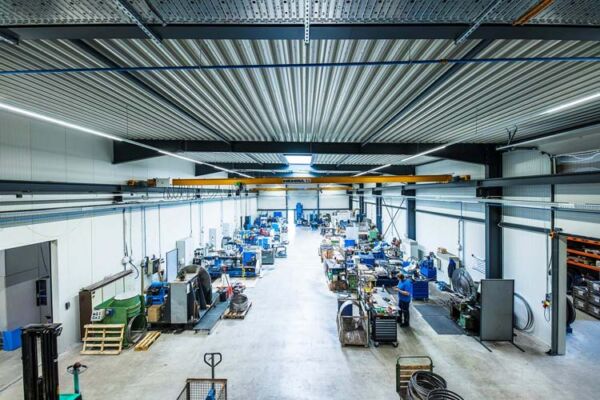
What Does Press Braking Mean? – Explained Simply and Clearly
Press braking refers to the targeted bending of sheet metal along a defined line. The goal is to shape a flat sheet into a component with one or more edges. The material is not cut or separated, but controllably deformed plastically.
Press braking is a classic forming process characterized by high precision and repeatability. It is used wherever exact angles, clean edges, and stable shapes are required. Thanks to modern CNC controls, even complex bending sequences with different bend radii can now be reliably and efficiently achieved.
How Does Press Braking Work Technically?
During press braking, the sheet metal is positioned between an upper tool (punch) and a V-shaped support, known as the die. The upper tool moves down in a controlled manner and presses the sheet into the die. This process creates the desired bend.
At UFG Gotha, the 3-point bending process is typically used. This process enables particularly high angular accuracy, since the sheet is guided at three precisely defined points. This allows deviations in material or sheet thickness to be better compensated for.
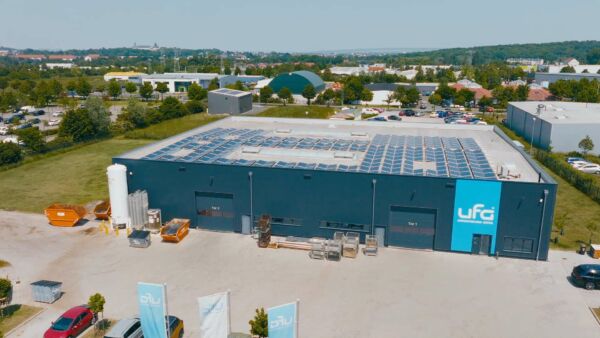
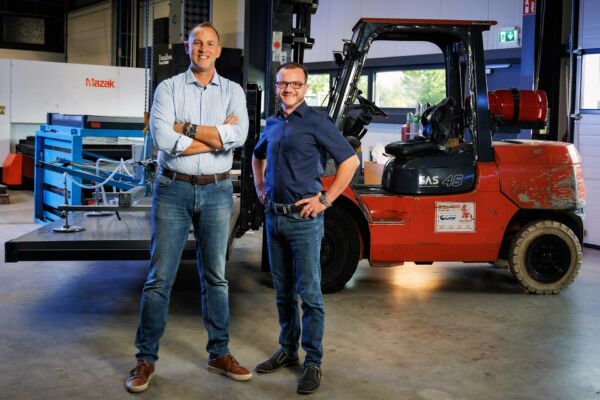
CNC Press Braking at UFG Gotha – Modern Technology for Precise Results
Our CNC-based press brakes form the technological heart of our production. They enable efficient, flexible, and highly precise processing of your sheet metal parts. Thanks to CNC control, all relevant parameters – such as bending angle, press force, and positioning – are precisely controlled and reproducibly set.
The press brakes at UFG Gotha feature:
- A press force of 1600 kN each
- A maximum working length of up to 3,000 mm
- Design for material thicknesses up to 15 mm
These technical capabilities allow us to reliably bend both delicate components and robust constructions. Our press brakes work with high precision.
Press Braking from Batch Size 1 – Maximum Flexibility
A particular advantage of our offering is the ability to manufacture press-braked parts starting from batch size 1. This is made possible by efficient setup processes, modern CNC technology, and well thought-out work preparation. For customers, this means maximum flexibility – for example, for prototypes, spare parts, or individual custom productions.
At the same time, press braking at UFG Gotha is also economically attractive for series production. Repeatable processes ensure that even larger quantities maintain consistently high quality.
Which Materials Are Suitable for Press Braking?
In principle, many metals and alloys can be press braked. Material thickness, formability, and desired final geometry are the decisive factors. Different materials react differently to the bending process, for example through springback or increased stress.
Typical materials processed in press braking include:
- Sheet steel
- Stainless steel
- Aluminum
- Galvanized sheets
- Special alloys
UFG Gotha helps you select the right material, taking into account both technical and economic aspects.
The Importance of Tool Variety in Press Braking
An often underestimated factor in press braking is the tooling used. Different punch and die shapes significantly influence the bending result. That’s why UFG Gotha keeps an extensive range of press brake tools on hand.
Thanks to this variety of tools, we can:
- Achieve different bend radii
- Precisely realize tight and open angles
- Process surfaces gently
- Enable complex component geometries
This ensures that the result exactly matches your expectations.



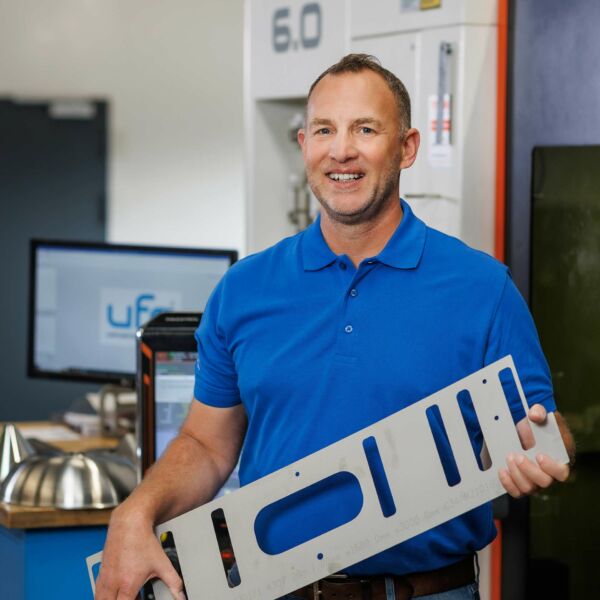
Typical Applications for Press-Braked Parts in Industry and Business
Press-braked sheet metal parts can be found in almost every industry. Their function ranges from load-bearing elements to precise housings and covers.
Mechanical and Plant Engineering
In mechanical engineering, press-braked sheets are frequently used for housings, protective covers, and structural components. Here, dimensional accuracy, stability, and load capacity are key.
Automotive and Supplier Industry
In the automotive industry, precision and repeatability play a central role. Press-braked parts are used, among other things, for brackets, covers, and functional components.
Electrical Engineering and Control Cabinet Construction
Here, exact angles, clean edges, and high dimensional accuracy are essential. Press-braked sheets form the basis for control cabinets and control housings.
Construction and Building Technology
Building technology also has numerous applications, for example in cladding, beams, or ventilation components.
Quality in Press Braking – A Decisive Factor
In press braking, quality determines the function, appearance, and assembly capability of a component. Even small angular deviations can cause parts not to fit or create stress.
At UFG Gotha, we therefore place great importance on:
- Precise CNC programming
- Suitable tool selection
- Controlled bending processes
- Experience working with different materials
This results in consistently high quality – from the first part to the last batch.
Frequently Asked Questions About Press Braking (FAQ)
Press Braking as Part of Holistic Metal Forming
Press braking is often not just a single work step, but part of a comprehensive manufacturing process. In combination with cutting, punching, or other forming processes, complete components and assemblies are created.
As experts in metal forming, we support our customers even with complex challenges. You show us your product idea – we show you our path to the product.
Press Braking at UFG Gotha – Precise Solutions with a System
Press braking is an indispensable process in modern sheet metal processing. It enables precise, stable, and economical components for almost every industry. With modern CNC press brakes, a wide range of tools, and years of experience, UFG Gotha offers the ideal conditions for high-quality press-braked parts – from one-off production to series.
Do you need precisely press-braked sheet metal parts? Send us your inquiry. Together, we’ll bring your idea into the right shape.


